SPF stands for Sun Protection Factor: a measure of protection against sunburn. SPF 50 means that, under test conditions, roughly fifty times the UV dose is needed to produce the same initial skin redness as on unprotected skin. The number mainly concerns UVB. Look for UVA protection too, apply enough sunscreen and reapply when outdoors.
A bottle often carries several different pieces of information: SPF 50, a plus sign, a UVA logo and a statement about water resistance. Each tells you something different. Understanding how they fit together helps you read the label and protect your face before a working day, walk or bike ride.
What does the SPF number tell you?
A higher SPF provides greater protection against sunburn under the same test conditions. The factor belongs to the tested product and the way it was applied. It does not tell you how many hours you can spend outside without concern.
Using sunscreen properly helps prevent skin cancer and protects against sunburn and premature skin ageing. For everyday facial protection, the AAD recommends at least SPF 30 with protection against both UVA and UVB. SPF 50 or 50+ provides higher protection against sunburn. Our facial sunscreen basics guide explains the habits that go with it.
What does an SPF test compare?
The measurement centres on the amount of UV needed to cause the first clearly visible redness. Researchers compare protected and unprotected skin under specified conditions. They divide the dose needed on protected skin by the dose needed without protection. That ratio is the SPF.
This is different from measuring how hot skin feels or how thick a cream seems. A light lotion and a rich cream can have the same SPF. Texture mainly tells you whether you enjoy using a product; its protection factor comes from testing. The FDA explains this relationship between UV doses.
The result mainly concerns UVB, which plays a large part in sunburn. UVA requires additional information. That is why it is useful to read beyond the large number on the front of the bottle.
SPF 50 in one simple example
Imagine that a test needs one unit of UV dose to just burn unprotected skin. With SPF 50 protection, it takes roughly fifty of those dose units to reach the same point. This example explains a ratio; the unit does not represent a minute.
You may also see SPF 50 described as blocking about 98% of UVB and allowing about 2% through. That is a simplified explanation for correct application. The remaining fraction is one fiftieth. This percentage does not describe protection against all solar radiation, and it does not mean your skin cancer risk becomes exactly 98% lower.
The useful point is that a higher SPF offers greater sunburn protection while careful application remains necessary. Cancer Council's explanation sets out the factor and the fraction that passes through.
Why the layer on your skin matters
The usual SPF test on skin applies 2 milligrams of product per square centimetre. This is a standard test amount. Applying less lowers protection, and the reduction is not neatly proportional to the amount. Half a layer of SPF 50 cannot reliably be treated as SPF 25.
At home, you do not need to measure every part of your face. Follow the quantity and directions on the packaging and spread sunscreen generously and evenly. You might work across your forehead first, then your cheeks, followed by your nose, chin and jawline. This gives each area attention instead of hurriedly spreading one small blob everywhere.
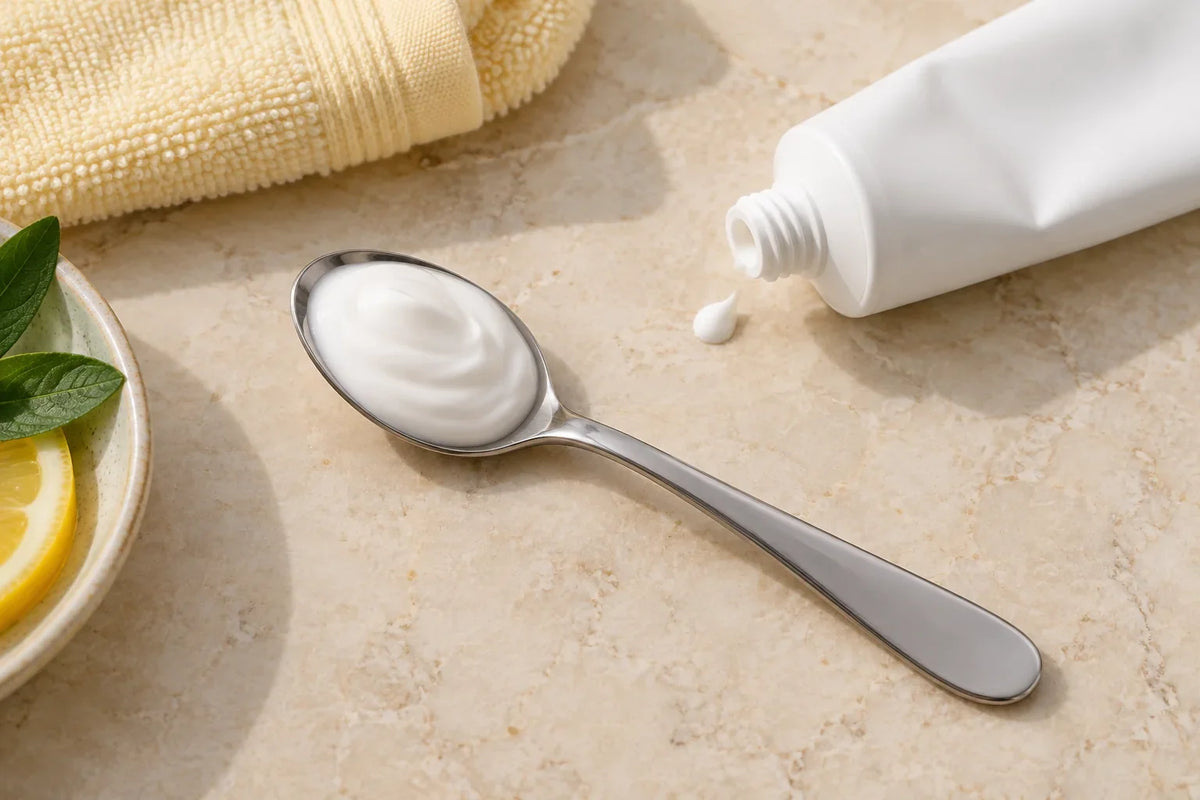
Remember the edges: the sides of your nose, your hairline and the outer parts of your ears. A well-covered cheek does not protect an ear you missed. Our guide to amounts for the face, neck and ears helps you include these areas. The photographs show the action; the visible dot of cream is not a measured total dose.


What does the plus sign in SPF 50+ mean?
On European labels, SPF 50 and SPF 50+ belong to different categories. The European recommendation links the SPF 50 label to a measured SPF of 50 up to, but not including, 60. SPF 50+ requires a measured SPF of at least 60. The corresponding descriptions are “high protection” and “very high protection”.
The plus sign therefore means the test result meets the threshold for the highest category. It does not indicate extra hours, water resistance or a more comfortable skin feel. Look elsewhere on the packaging for that information.
This classification comes from the European recommendation on sunscreen claims. Labels elsewhere in the world may use different numbers or terms. Read these thresholds in their European context.
Why look for the UVA logo too?
UVA contributes to skin ageing and, like UVB, plays a part in skin cancer. You want protection against both. A high SPF alone does not give you a complete picture of UVA protection.
European sunscreens often display the letters UVA inside a circle. This logo indicates UVA protection in line with the European recommendation. Among its requirements is a UVA protection factor of at least one third of the labelled SPF. This is a ratio between protection factors, not a percentage of sunlight.
You do not need to calculate that ratio while shopping. Look for both the SPF number and the UVA indication. On a US label, broad spectrum means the product also protects against UVA; US labelling requirements are not identical to European ones. The European Commission explains the UVA logo.
Outdoors, also plan for shade and use clothing, a hat and sunglasses. A bench under trees or lunch beneath a canopy makes protection an ordinary part of your day.

Why can you not convert SPF into hours?
The UV dose your skin receives depends on the strength of the UV and your time outside. The same walk can deliver a different dose around midday than early in the morning. Cloud cover, location and season also matter. “I burn in ten minutes, so SPF 50 gives me five hundred minutes” is not a workable plan.
The layer on your face also changes. After cycling, you might wipe sweat away with a towel. Swimming, heavy sweating and towelling can remove protection. Outdoors, reapply about every two hours, and after these activities according to the directions.
Take sunscreen with you if you will be outside again later. For exercise, read what water and sweat resistance mean. The SPF number does not replace those separate instructions.


Read your packaging in three steps
- Find the protection information. Read the SPF and UVA indication together. Look for the protection details themselves, rather than relying on descriptions of texture or appearance.
- Read the directions. Check how much to apply, when to apply it and what the label says about reapplication. If you will swim or exercise, check water resistance too.
- Think through your time outside. A tube by the basin helps in the morning; keeping one in your bag helps later. Include your exposed neck and ears, and consider where clothing or shade can help.

Common questions about SPF
Do SPF numbers in moisturiser and make-up add together?
No. SPF 20 in your moisturiser plus SPF 10 in your foundation does not become SPF 30. The numbers belong to separately tested products. Apply enough sunscreen on its own, then make-up if you wish. Cancer Council explains this misconception about adding SPF.
Does SPF 50 mean something different on darker skin?
The definition of SPF does not change with skin tone. How quickly skin burns and how clearly redness shows can differ. Darker skin also benefits from UV protection. Choose a product that spreads comfortably so you are happy to use the recommended amount.
Do I still need to reapply SPF 50+?
Yes. The plus sign does not change reapplication times. Follow the advice above outdoors and the directions on your own packaging. For a long day, put sunscreen with the things you will take along so you can do more than apply it once in the morning.
Soluveli is still in development. We are working on facial sunscreen that fits comfortably into a daily routine; SPF 50+ is a development goal that still needs confirmation through product testing. Visit the Soluveli homepage to learn about development. Join the launch list for one message when we launch.
Sources and further reading
8 sources
- European Commission — Recommendation 2006/647/ECSPF definition, test quantity, categories and the SPF 50+ threshold.
- FDA — Sun Protection FactorUV dose and why SPF does not predict a number of hours.
- Cancer Council Australia — Fact sheet: SunscreenSPF and the transmitted fraction, correct use and additional protection.
- AAD — Sunscreen FAQsUVA and UVB protection, SPF 30 or higher and reapplication.
- European Commission — Sunscreen productsPurpose and meaning of the standardised UVA logo.
- Cosmetics Europe — Sunscreens: use and labellingThe UVA circle, protection-factor ratio and use instructions.
- FDA — Sunscreen: how to help protect your skinBroad spectrum and use advice. US labelling requirements are identified separately.
- Cancer Council Australia — SPF in face creams and make-upWhy SPF numbers from different products do not add together.