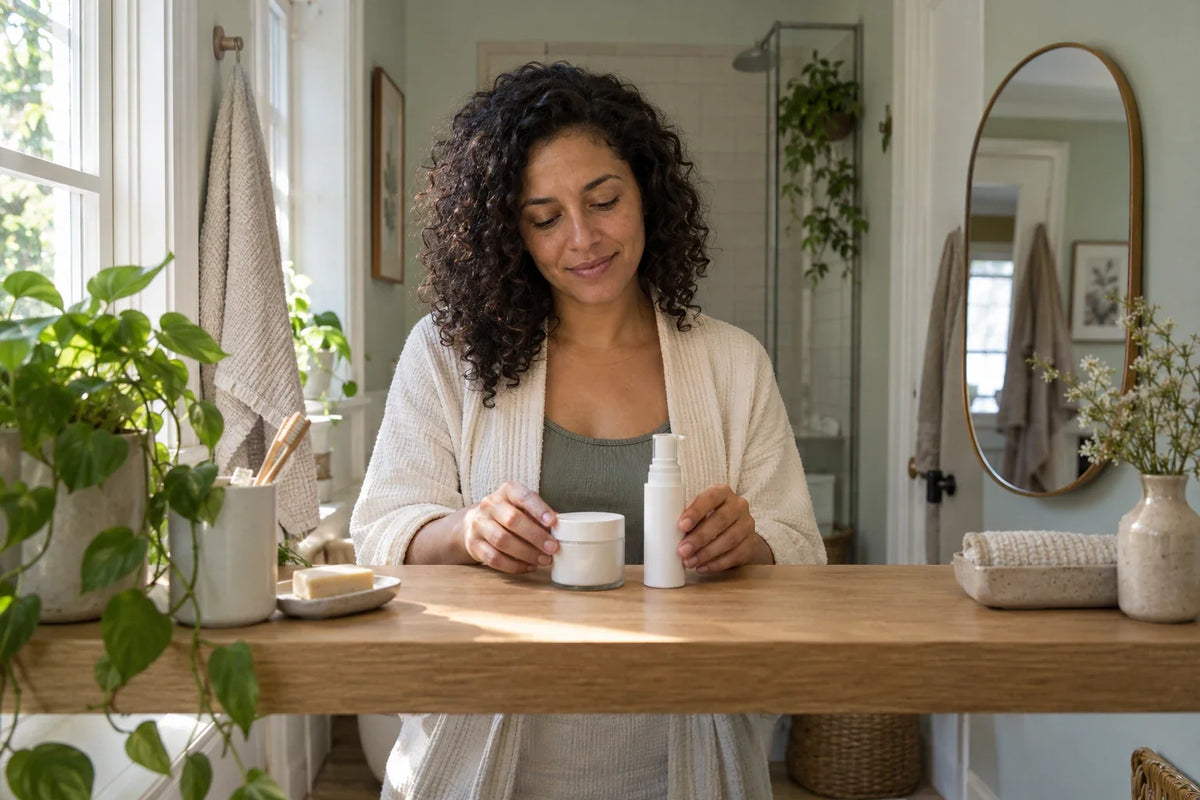
Care for acne-prone skin with a gentle cleanser, suitable moisturiser and as few irritating extras as possible. If you use an acne treatment, follow the advice given for your own plan. Scrubbing harder or trying a new product every week often makes a routine harder to settle into. A simple plan helps keep your skin comfortable and makes treatment easier to maintain; skincare does not replace treatment.
What skincare can do
Spots and a shiny forehead do not mean you need to wash your face more vigorously. Acne develops around blocked hair follicles and can involve inflammation. Even skin that feels oily can become dry, tight or sensitive during treatment. The aim at the basin is to cleanse without adding more irritation.
Separate three questions: what cleans your skin comfortably, what helps with dryness, and which treatment suits your acne? The first two concern everyday skincare. A pharmacist or doctor can advise on the third. That way, you do not have to judge a moisturiser as though it should clear every spot by itself.
Cleanse gently, without scrubbing
Choose a gentle, non-abrasive facial cleanser and apply it with your fingertips. The American Academy of Dermatology recommends gentle washing up to twice a day and after sweating. Morning and evening can provide a useful rhythm; a shiny nose during the working day is not, by itself, a reason for another full wash.
Leave out harsh scrubs, cleansing brushes and rough sponges. Rinse off the cleanser and gently pat your face dry. Clean skin does not have to feel stripped or tight. If washing repeatedly leaves your skin stinging or very tight, ask whether your cleanser, other products and treatment could be better matched.

Take cycling to work as an example. If you have sweated heavily, make time for gentle cleansing rather than rubbing briskly with a towel. Advice to wash after sweating is not a reason to follow it with a scrub, an astringent and an extra acid.

Moisturise skin that is both oily and dry
A moisturiser can help when acne treatment makes your skin dry or irritated. Skin can feel oily and still need moisture. Apply suitable skincare after washing; follow your treatment instructions for its order in relation to a prescribed product.
Labels such as oil-free and non-comedogenic can help you choose. Non-comedogenic means a product is designed not to clog pores. It is not a personal guarantee that you will never get spots while using it. Also consider how the product feels and whether your skin tolerates it.

Here, a moisturiser is support, not a stand-alone acne cure. The studies discussed by the AAD combine skincare with cleanser and acne medication. Improvement within that treatment plan cannot be attributed to the cream alone. You do not need to buy several new products at once: start by listing what you already use and discussing where the dryness occurs.

Make mornings and evenings manageable
A useful routine fits an ordinary workday and a late evening. Keep the essentials together and your treatment instructions handy. This outline helps with organisation; it does not set medication doses or application times.
| When | Practical essentials |
|---|---|
| Morning | Cleanse gently and moisturise as needed. Plan sun protection if you are going outside. |
| Evening | Remove make-up, cleanse gently and care for your skin according to the advice you were given. |
| After heavy sweating | Wash gently; do not add a harsh scrub or extra astringent. |
| Your treatment | Follow the agreed amount, order and frequency. Ask for an explanation if anything is unclear. |
A prescribed product may have specific instructions, such as applying it to dry skin. Do not simply sandwich it between skincare layers because a general routine suggests doing so. Ask a pharmacist or your clinician to help if your instructions are difficult to fit into the day.
Make-up, hands and the moments in between
Remove make-up at the end of the day with a suitable gentle cleanser. Aim to get your skin clean without repeated hard rubbing. If your current product makes that uncomfortable, ask about a better-suited cleanser rather than using more force.
Do not squeeze or pick at spots. This can delay healing and increase the risk of scars and dark marks. Checking the mirror after lunch does not need to become another treatment session. Keep your hands occupied elsewhere and save your routine for the planned time.

If sunscreen stays shiny, sticky or pills, that is a separate question from treating acne. Our guide to sunscreen for oily skin explains how to choose a comfortable texture and a manageable application routine. A pleasant finish does not, by itself, tell you whether a product treats acne.
Protect your skin outdoors
Using sunlight or a sunbed to dry out spots is not a good treatment. UV damages skin, and some acne medicines make it more sensitive to sunlight. Outdoors, combine shade, clothing and a hat with broad-spectrum sunscreen of at least SPF 30 on uncovered skin. Choose water resistance for sweating or water exposure, and follow the label and your treatment advice.
Applying sunscreen properly helps prevent skin cancer and protects against sunburn and premature skin ageing. Apply enough before going outside. While you remain outdoors, reapply about every two hours, and straight after swimming or heavy sweating as directed on the label. Sunscreen does not treat acne.

A lunchtime walk in October calls for attention to that day's conditions, not just the month. Check the UV index and what it means for protection, consider how long you will be outside and follow any extra medication instructions. Outdoor reapplication advice does not create a fixed timer for a day spent indoors.
Unsure how much to spread over your face, neck and ears? Our guide to applying enough sunscreen makes that step more practical. Apply your chosen amount carefully; a higher SPF does not automatically make a very thin layer sufficient.
Give your treatment plan a fair chance
A new treatment often takes weeks to months before you see a difference. Avoid repeatedly changing your approach on your own. Wanting to do something extra after a difficult skin day is understandable, but another exfoliant may mainly add irritation. Discuss treatment changes with a pharmacist or your clinician.
Make the conversation concrete: which product are you using, how often, what feels dry or painful, and when did it start? A brief note helps you remember those questions. You do not need daily photos or an elaborate tracking system to ask for help. Discuss troublesome side effects and what to do about them; do not change a prescription schedule on the basis of a general blog.
When self-care is not enough
See a doctor if self-care is not helping, you have many spots, or you develop deep, painful lesions or scarring. Feeling anxious, low or self-conscious because of acne is also a good reason to ask for help. You do not need to wait until other people think your skin problems are serious enough.
Have hot, swollen and painful skin assessed, especially if symptoms worsen quickly. Redness may be less obvious on darker skin; pay attention to heat, swelling and pain too. If you are unsure whether it is acne, ask for an assessment rather than diagnosing it from photographs.

Leave room for an ordinary day
A good routine does not need to take over your bathroom. Choose steps your skin tolerates, follow your own treatment plan and discuss anything that feels uncomfortable. Cleansing and skincare can then become everyday habits alongside work, exercise and time outdoors.
Soluveli is developing facial sunscreen. Visit the homepage to read about the plans and sign up for one message on launch day. There is no tested Soluveli effect on acne to promise; this guide covers general skincare and suitable sun protection.
Sources and further reading
4
- American Academy of Dermatology — Acne: Tips for managingGentle cleansing, limiting irritating extras, allowing treatment time and sun protection.
- American Academy of Dermatology — Moisturizer and acneMoisturising for dryness during acne treatment. The research discussed involves combined treatment plans, not a moisturiser alone.
- NHS — AcneRemoving make-up, symptoms and reasons to seek medical help. No medicine or supplement recommendations have been adopted.
- American Academy of Dermatology — How to apply sunscreenBroad-spectrum protection, applying enough and reapplying while outdoors.