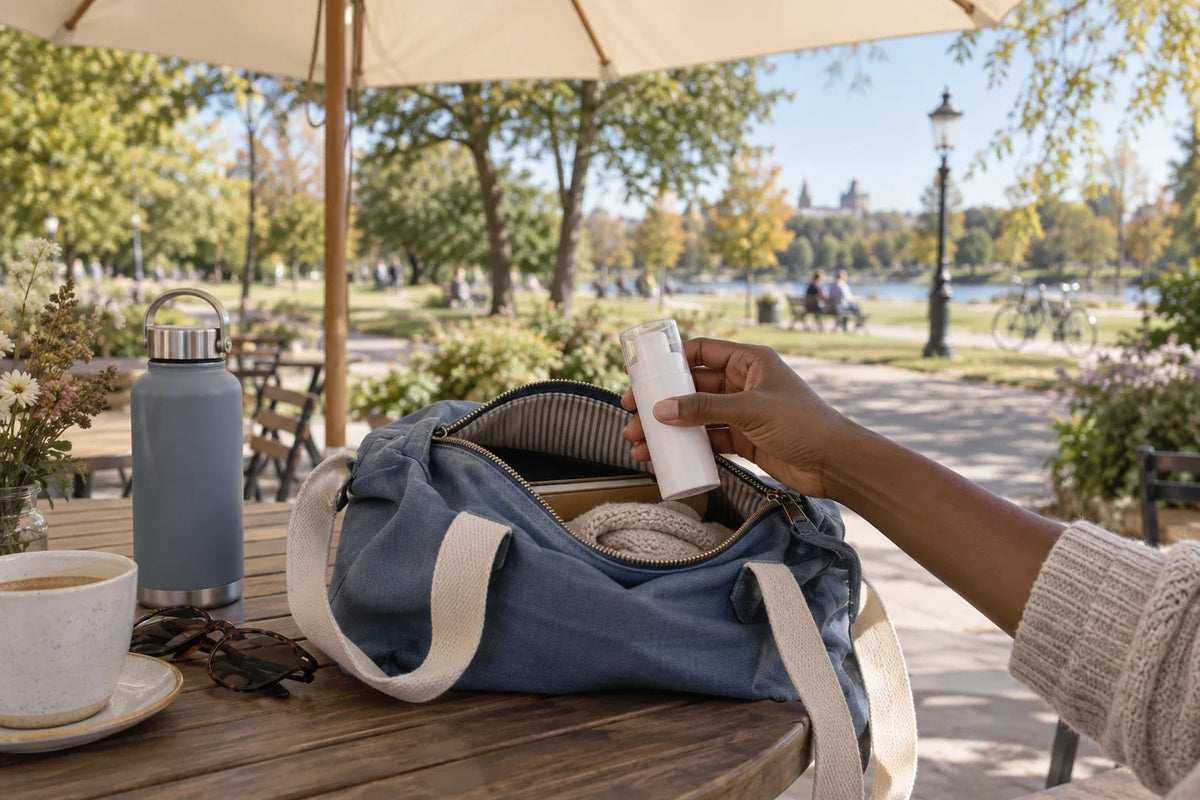
Store sunscreen as directed on the label, away from direct sunlight and excessive heat. At home, that might mean a drawer or cupboard; when you go out, carry it in a bag you keep in the shade. Avoid using a parked car as its regular home. A useful plan starts with where your tube or bottle goes after you apply it.
Give sunscreen a regular place at home
Choose somewhere you can find it easily, away from a sunny windowsill or a heat source. A hallway shelf out of the sun can be handy: you pick up your keys and sunscreen together. If that spot gets warm, choose another that meets the storage instructions on the packaging.
Read the instructions on your own product. This general advice cannot give you a single temperature limit that applies to every sunscreen. You do not need to buy a special storage system, either. Having a regular spot mainly helps stop the bottle being left somewhere unsuitable after use.

Keep it ready for your break at work
Do you go for a walk or eat lunch outside during the working day? Keep sunscreen within reach, perhaps in a desk drawer that stays away from heat. That keeps it out of direct window light and makes it easy to grab before your break. Again, follow the label: a drawer beside a heat source is not a good choice just because it closes.
Good storage is only one step. For application, read how much sunscreen to use on your face, neck and ears. Put the container back straight after applying it, or take it with you if you will be outside for longer.

Carry it in a bag that stays out of the sun
Close the cap after use and give the container its own compartment so you can find it easily. On a terrace or at a picnic, put your bag in the shade. Check again later: the shade moves, while your bag often stays in the same place.
The US FDA advises protecting the container from direct sunlight and excessive heat. Outdoors, it suggests shade or wrapping the container in a towel. A bag or towel is no guarantee that the product stays cool; pay attention to where you leave your belongings.

Put it back in the shade after sport
A sports bag beside the court or near a bench makes reapplication easier, as long as you choose its spot carefully. Find somewhere out of the sun, close the container and put it away again after use. Bring the bag indoors after training.
Storage is separate from how long the applied layer stays on your skin. Swimming, sweating and towelling off mean you need to pay attention to reapplying as directed on the label. Our guide to sunscreen for sport and water resistance helps you plan when to do that.

Use the car for the journey, not for storage
A tube in the glove compartment sounds convenient: there is always one with you. But an enclosed car can get hot even when the tube is out of direct sunlight. The American Academy of Dermatology advises against keeping sunscreen in a hot car, because heat can speed up the breakdown of ingredients.
Take your sunscreen with your bag when you get out. Whether it is on the dashboard, under the seat or in the door pocket, it is still in the same hot car. Do not turn any of these spots into permanent storage.

What if it has already got hot?
Have you found the container in a hot car? Take it out and check the storage information and the contents. The AAD lists changes in colour, smell or texture as reasons to replace sunscreen, even before its expiry date. Examples include an unusual smell, separated layers or a dry, flaky consistency.
Looking normal does not, in turn, prove how much protection remains. Nor does the container feeling cool again tell you the SPF of what is inside. These sources provide no universal safe time in a car or fixed percentage of protection lost. If you are unsure, ask the manufacturer about your product and what happened; meanwhile, choose sunscreen whose storage history and condition are clear.
For dates, when you first opened it and deciding what to do with an old container, read whether last year's sunscreen is still good.

Bring it indoors with your keys
Make it a simple habit: pick up your keys, take your bag and put your sunscreen in its usual place. When you get home, check whether it is still in your sports bag or the car. Your next time outdoors can then start with a container you can find and whose storage history you know.
This fits into a daily sun protection routine: store carefully, apply generously and use clothing and shade outdoors too. Applying sunscreen properly, wearing protective clothing and seeking shade help prevent sunburn and premature skin ageing from the sun, and reduce the risk of skin cancer.

Soluveli is still in development. Read about our ambitions on the homepage; you can join the launch list for one message when we launch.
Sources and further reading
3 sources
- American Academy of Dermatology — Sunscreen FAQsAdvice to keep sunscreen out of direct sunlight and hot places such as cars.
- American Academy of Dermatology — When to toss your makeup and sunscreenSigns of deterioration and the effect of heat before the expiry date.
- FDA — Sunscreen: How to Help Protect Your Skin from the SunStorage away from excessive heat and direct sunlight; SPF is established through testing. US labelling rules do not automatically apply in Europe.