Plan sun protection for your ride to work and your ride home. Before cycling in daylight, apply enough sunscreen to skin that clothing does not cover, following the label. Before returning, check the UV index, your route and how long you will be outside again. After a working day, the morning's application is not something you can automatically rely on for the journey home.
Start with the journey you will actually make
A jacket, cool air on your face and a sunny cycle path: the temperature does not tell you how much UV radiation reaches your skin. The UV index helps you assess that. WHO recommends sun protection from UV index 3, and the Dutch RIVM gives protection advice from the same level. Clouds may reduce UV radiation, but they do not automatically make a ride UV-free. [1, 2]
Check the local UV forecast for your departure time. A short ride in darkness differs from a long lunchtime ride or a sunny journey home. At a low UV index, consider the duration and the skin exposed; a value below 3 is not a promise that every situation is risk-free. Our guide to the UV index and everyday sun protection explains the factors to consider.
Look at your route too. An exposed embankment, a detour through town and a sheltered cycle path offer different conditions. Shade usefully complements clothing and sunscreen. A few trees alone cannot remove all exposure.

Apply sunscreen at home before getting on your bike
Choose sunscreen with at least SPF 30 and protection against both UVA and UVB. If you sweat heavily while cycling, also check its water-resistance claim and reapplication instructions. Water-resistant does not mean it stays effective throughout a working day. Our guide to sunscreen for sport and sweating helps you understand the label. [3, 4, 5]
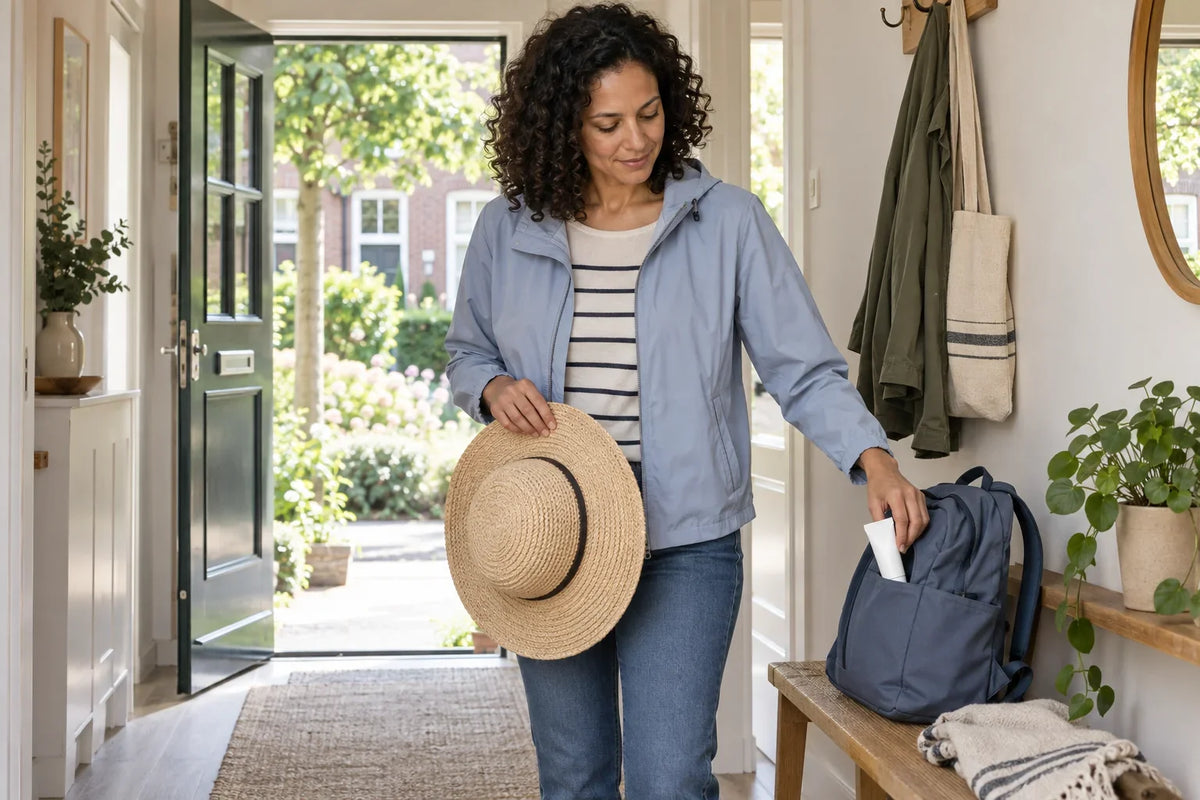
Keep the product beside something you use before leaving, such as your keys. Take time to spread it evenly over uncovered skin and follow the stated application time before exposure. The American Academy of Dermatology advises applying sunscreen about 15 minutes before going outdoors. Apply it while stationary; keep both hands on the handlebars while riding. [3]

Check the exposed areas: your face, outer ears, neck and the back of your neck, and possibly your hands or forearms. Where clothing covers skin well, that coverage is part of your protection. A bicycle helmet matters for safety, but it does not fully cover your ears, nose or neck. A narrow helmet strap is not a substitute for sunscreen on those areas.
Use enough, following the label. A small dab of cream in a photograph illustrates application, not the total amount you need. If you also use skincare or makeup, spread the sunscreen carefully and let the layers settle before putting on your helmet. A higher SPF is no reason to use less product.

On arrival, consider sweating and towel drying
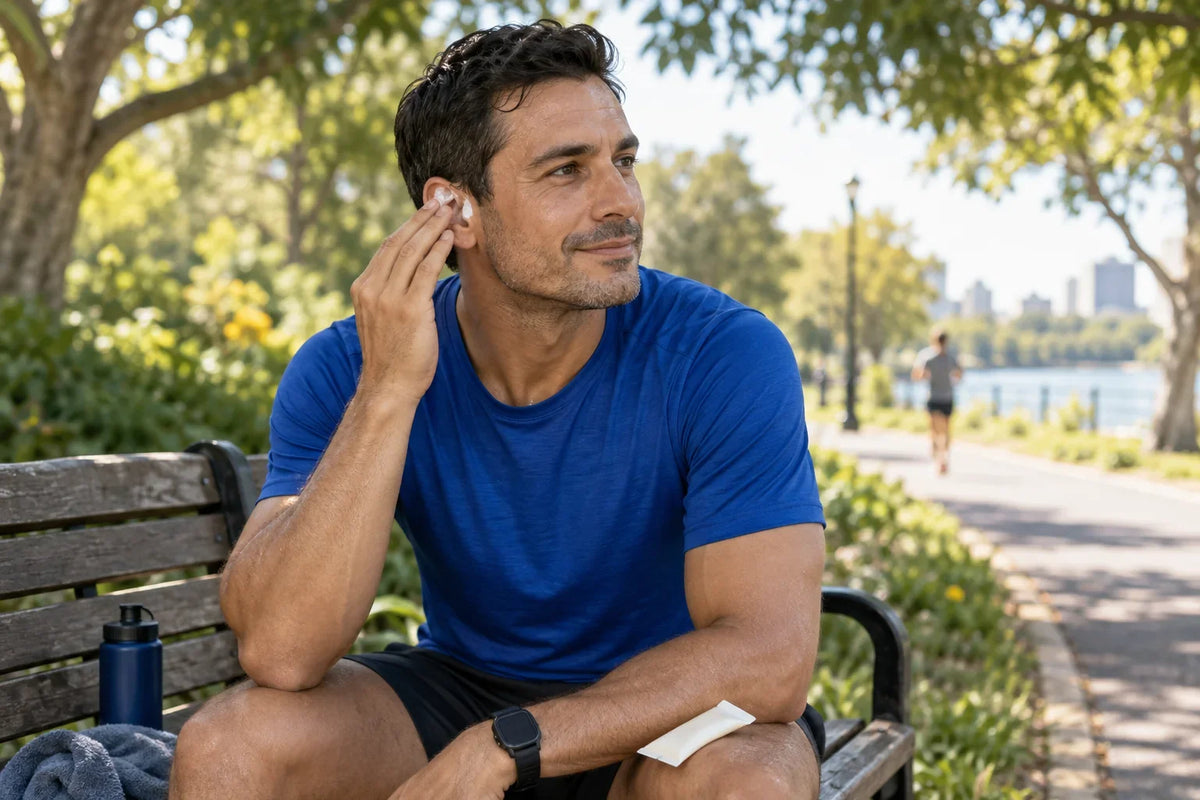
After a brisk ride, you may want to pat your face dry. Do so gently with a clean towel. Heavy sweating and towel drying can mean you need to reapply sunscreen; follow your product's instructions. Reapply before going outside again if protection has been wiped off or the label says it is time. [3, 5]
If you then stay inside at work, do not turn this into an automatic two-hour indoor routine. The advice to reapply about every two hours refers to time outdoors. A lunchtime walk, an outdoor meeting and the ride home are fresh occasions to assess exposure. Your morning sunscreen does not need hourly touching up simply because you are indoors, but neither does it give you a free pass for an afternoon outside. [3, 4]
A useful habit is to put the product somewhere visible in your bag or near your desk after freshening up. That makes it easier to remember before setting off home.

Make a fresh plan for the ride home
Before leaving, check the current UV index and the length of your return journey. Include time spent shopping, collecting a child or taking a detour. Apply enough sunscreen again to uncovered skin before the ride when your exposure and the label call for it. After a whole working day, do not rely solely on the morning's application.
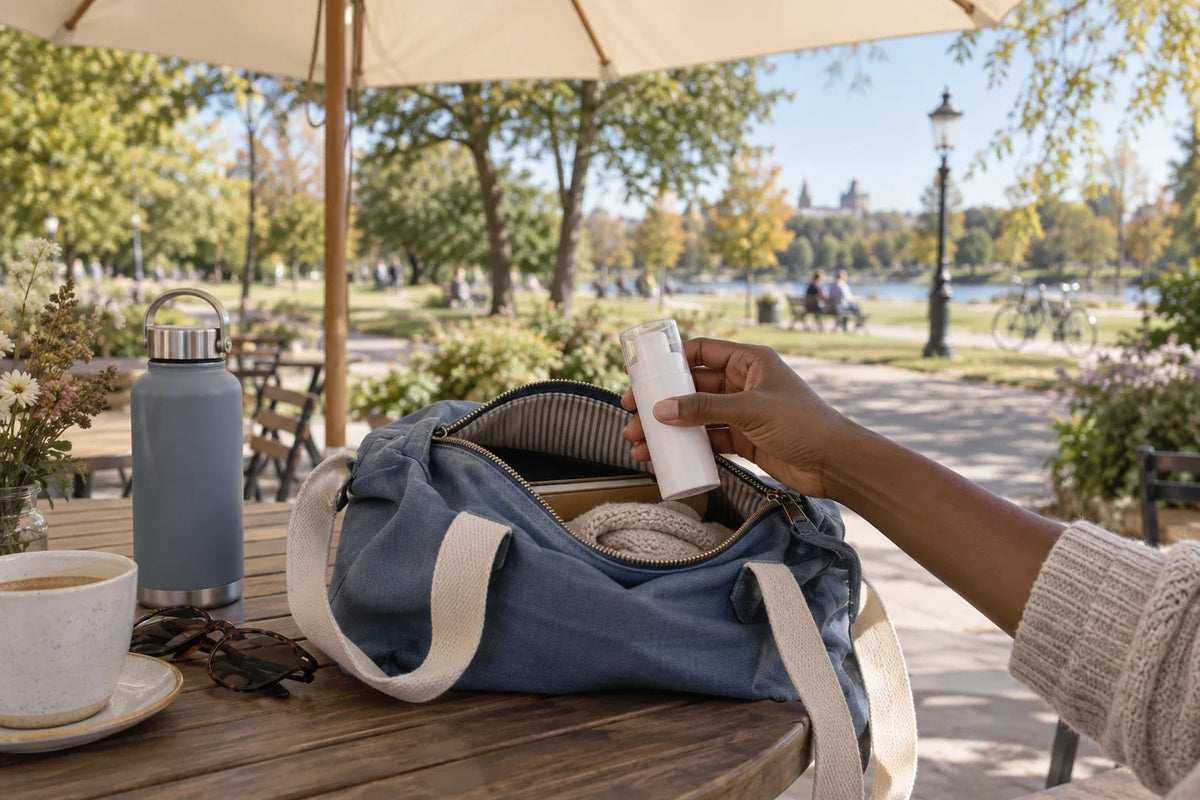
Give sunscreen, a clean cloth and suitable sunglasses a regular place in your bag. WHO and RIVM include UV-protective sunglasses in sun protection advice. Store sunscreen according to the label; do not leave it all day on a hot dashboard or in direct sunlight. Check the expiry date too. [1, 2, 5]
If you need to reapply on the way, stop your bike safely away from the road. Find shade where possible. Apply the sunscreen before continuing and allow for the instructions on the packaging. Preparing beforehand is easier than trying to retrieve a product from your bag while cycling.
Our guide to why facial sunscreen matters explains how sunscreen, clothing and shade work together against sunburn and sun damage.

What an ordinary working day could look like
This schedule is an example routine, not a fixed protection time. Adapt it to your departure times, the current UV index and the product label.
| When | What to consider | Practical step |
|---|---|---|
| Before cycling to work | Daylight, local UV index and uncovered skin | Choose clothing and apply enough sunscreen where needed before leaving |
| On arrival | Have you sweated heavily or dried your face? | Freshen up and reapply before your next outdoor activity according to the label |
| Before an outdoor break | How long will you be outside, and is there shade? | Reassess protection; reapply about every two hours while outdoors |
| Before cycling home | UV index, route and any detour | Apply enough where needed; do not automatically rely on the morning's layer |

A cool morning and a sunny ride home can call for different choices. A dark winter commute does not need the same application plan as a long daylight ride. The aim is a habit that adapts to your day.
Soluveli is in development. Visit our homepage to read our ambitions for everyday sun protection. If you would like to hear when there is more news, sign up for our launch notification.

Questions about cycling and sunscreen
Do I always need to reapply for a short ride?
There is no universal number of cycling minutes below which everyone can leave without protection. Consider the UV index, exposed skin, what you have applied already and the instructions. Treat a return ride after a whole day as a new outdoor activity.
Can a higher SPF spare me from reapplying all day?
No. SPF does not turn sunscreen into a clock or remove the need to reapply after sweating, swimming or towel drying as instructed. Outdoors, the general advice is to reapply about every two hours. Our explanation of the difference between SPF 30 and SPF 50 gives more context. [3, 4]
What if I wear makeup?
Plan to apply a proper layer of sunscreen to uncovered skin before leaving. An SPF claim on makeup does not automatically replace an adequate sunscreen application. If you need to reapply, do so carefully and follow your sunscreen's label; touching up with a little powder alone is not an equivalent routine. [4]
Sources
5 sources
- RIVM — Bescherm uzelf: tips bij zonkracht 3 of hogerDutch advice on the UV index, clothing, shade, sunscreen and sunglasses; the thresholds do not define a personal safe exposure time.
- WHO — Ultraviolet radiationInternational guidance on the UV index, cloud cover and combined sun protection.
- American Academy of Dermatology — How to apply sunscreenAdvice on applying enough sunscreen before exposure, uncovered areas and reapplication while outdoors.
- American Academy of Dermatology — Sunscreen FAQsExplanation of SPF, UVA/UVB, water resistance and the limitations of SPF in makeup.
- FDA — Sunscreen: How to Help Protect Your Skin from the SunAdvice on labels, reapplication and sunscreen storage.